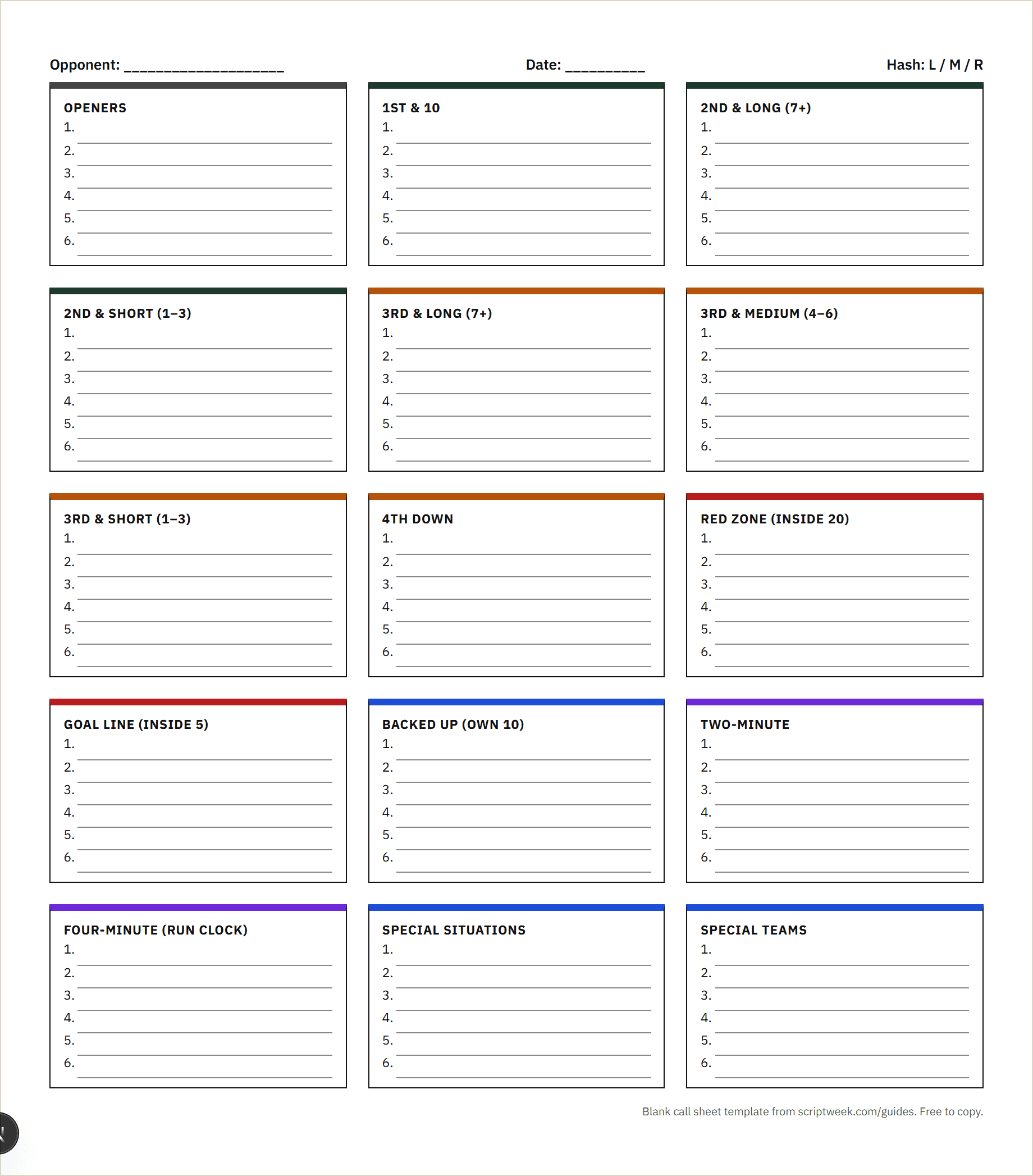
How a call sheet is organized
A call sheet is one page of plays grouped by situation, in the order you want to call them. The situation is the box, the plays inside it are your calls, and the order inside the box is call order: the top play is what you call first in that situation, the second is what you call if the first one gets stopped. The decision was made on Tuesday with film and coffee. Friday is a glance, not a search.
The boxes on this template are color coded by group, so your eye finds third down or the red zone without reading. Early downs are green, third and fourth down are orange, scoring situations are red, field position is blue and clock situations are purple.
What the fifteen boxes are
- Openers: your first six scripted calls, in order, so the game starts on your terms.
- 1st and 10, 2nd and long (7 plus), 2nd and short (1 to 3).
- 3rd and long (7 plus), 3rd and medium (4 to 6), 3rd and short (1 to 3), and 4th down.
- Red zone (inside the 20) and goal line (inside the 5).
- Backed up (inside your own 10).
- Two minute, and four minute for running the clock with a lead.
- Special situations: first play after a turnover, the trick play you installed this week.
- Special teams: the fake, the onside, the swinging gate.
There is a hash line at the top for coaches whose calls change by hash. Most youth offenses do not need it. Circle it or ignore it.
How many plays go in a box
Three to six. Every box on this sheet has six lines, and that is fewer than you will want, on purpose. Three plays you would actually call beats eight you would not. If a box stays empty after you have gone through the playbook, that is information too: it tells you where the install is thin this week.
Filling it in
Write the play's number and its name on each line, in the order you would call them. If you use wristbands, the number on the sheet has to match the number on the band, so write the sheet first and copy the bands from it, never the other way around. Keep notes to a few words: vs Over only, if the corner is soft. Anything longer belongs in practice. Build it Thursday night, not Friday afternoon, so you look at it once with fresh eyes before it matters.
Printing and laminating
- Letter paper, portrait, 100 percent scale. The boxes are sized to fit one page.
- Print with backgrounds on so the colored box tops come through. In most browsers that is a checkbox under More settings.
- Type big enough to read at arm's length under stadium lights. If you are writing tiny to fit more in, you have too many plays.
- Laminate it or use a sheet protector. Rain, sweat and a wristband elastic will destroy paper by the second quarter.
- Print two. One for the play caller, one for the coach on the headset.
A call sheet that fills itself
This template is the by hand version of what Script Week does with tags. Tag a play once with the situations it is built for, and every box on the sheet fills from those tags, in your order, with the numbers dealt for the wristbands from the same list. Drawing and tagging plays is free for one coach, and so is your first call sheet.